• 1 Post
  • 10 Comments
Joined 5 months ago
cake
Cake day: February 6th, 2026

help-circle


  • I don’t know where you’re getting any of that from. It was travelling at 8 knots before and after the turnaround. The bit in the animation where it slows and drifts almost due south is actually marinetraffic not having AIS data for that period so it just interpolates between the two known positions. Maybe I should have made that clearer.

    That turnaround period is also close to 3.5 (edit: 2.5) hours, not 30 minutes.

    According to the same data the ship is now close to the Strait of Hormuz that it passed through yesterday; it seems pretty clear it did not get where it wanted to go.


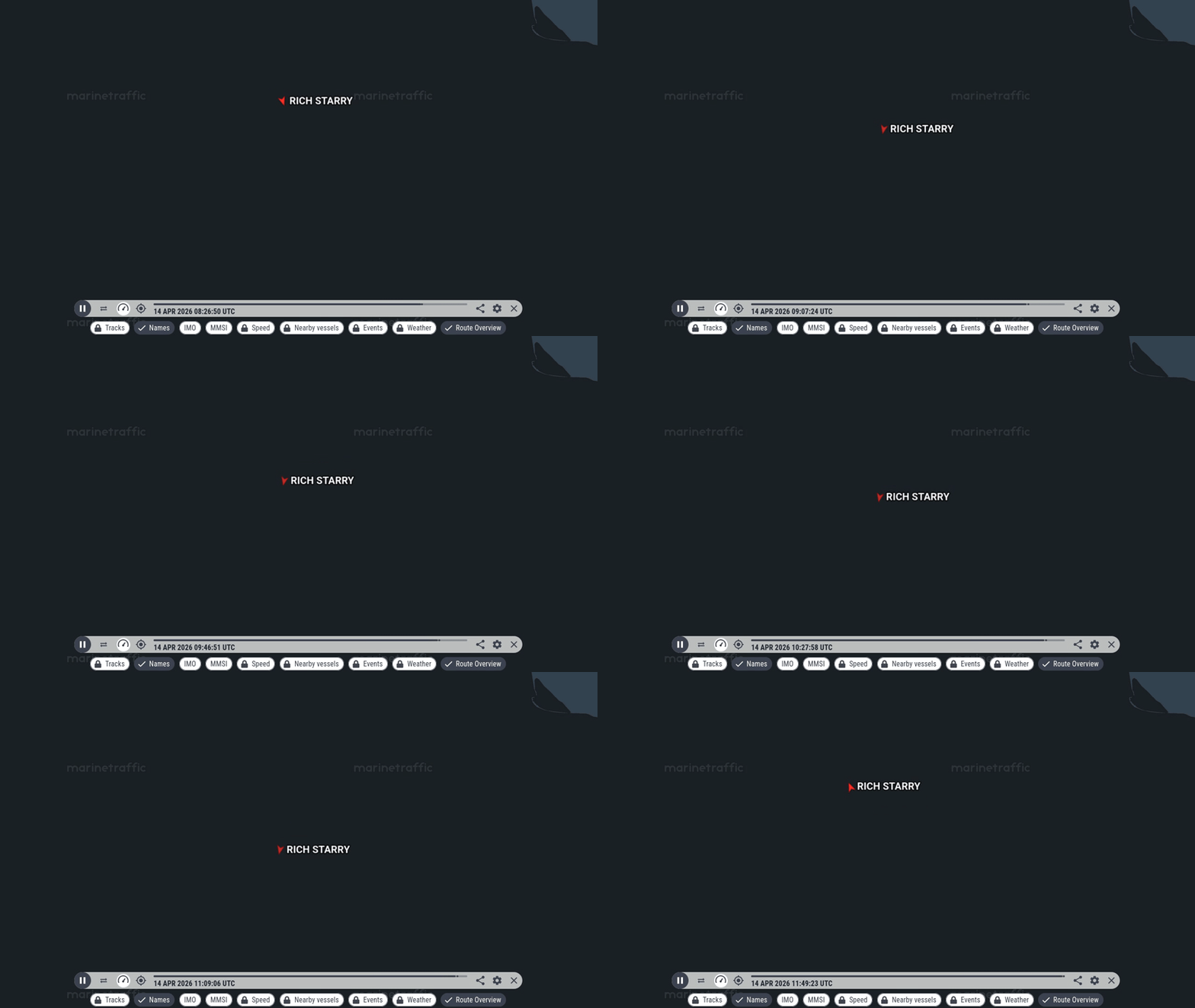
  • Everyone is reporting on these ships making it through the strait which is still under Iranian control. Few seem to mention the part in the Gulf of Oman where the US is actually implementing its blockade. The poster child, Rich Starry, mentioned in the article, did this a few hours after clearing the strait, still far from the Arabian Sea:

    Marine tracker timelapse showing RICH STARRY travelling southeast out of the Strait of Hormuz, halting and showing stale data for around 3.5 hours, and then returning back the way it came at speed.

    That sure doesn’t look like a ship breaching a blockade without incident.

    It’s too early to say how this will play out on a larger scale but for these specific ships a lot of reporting is really fucking misleading at the moment.


  • apparia@discuss.tchncs.detoPrivacy@lemmy.mlIs GPS private?
    link
    fedilink
    English
    arrow-up
    5
    ·
    5 months ago

    My first answer is “WTF is RTK?”; my answer after consulting Wikipedia is “no, they’re separate things”.

    RTK doesn’t sound like it broadcasts any data out but I barely understood what I just read. The Wikipedia coverage on this whole topic seems rather poor quality, I don’t think it’s just because I’m dumb.


  • apparia@discuss.tchncs.detoPrivacy@lemmy.mlIs GPS private?
    link
    fedilink
    English
    arrow-up
    23
    ·
    5 months ago

    It’s not as clear-cut as most people here are saying.

    In short, GPS itself is just listening to satellites, and nothing is leaked that way, but most modern phones use “Assisted GPS” of some sort. The most common (I believe) AGPS is SUPL, which seems to be used by most phones. This involves sending your approximate location to an Internet server, which returns satellite data based on that approximate location.

    To nobody’s surprise, in Android this is a Google server. I’m pretty sure most Android distros don’t give you any control over when it’s used, or which servers it uses. Anecdotally, my phone without Google Play services has a horrible time obtaining a GPS fix, so I suspect without GPlay it’s only using raw GPS, but I’ve not bothered to actually dig into it.

    As I understand it, SUPL means even if you’re in aeroplane mode, if you have an Internet connection over WiFi you might still be leaking (approximate) location data when using GPS.

    I learned about this from this excellent series of blog posts, which is a very thorough comparison of various Android ROMs’ privacy. It has a background section (search for “Assisted GPS”) in each of the ROM-specific posts which explains it better than I can.


  • This definition of social media is new to me as well, thanks for sharing it. This sort of clarifies a term I really dislike, and which you’ve used: “the algorithm”. It’s always seemed a little murky to me which algorithms it refers to. It’s like saying “don’t eat food with chemicals in it”.

    Lemmy does have “an algorithm”, it’s just a relatively simple one based on communities one is subscribed to plus some vote/comment data for the various sort orderings.

    Lemmy also absolutely implements a social graph – the data about who has interacted with whom is all stored by the system. It’s not explicitly stored as a graph structure, but then we’re arguing database schemas.

    As I understand it, however, you’re saying “social media” arises when the “social graph” data structure is used as an input to “the algorithm”. That seems like a pretty robust definition to me.

    One bit of pedantry: user blocks on Lemmy are, by a general definition, a form of social graph, and they do affect what content people see. So Lemmy could technically qualify as social media by the definition I’ve written here. I’m not sure what a more precise definition could be that avoids this technicality.