

3·
16 小时前Sigh, people in this sub keep posting nice things without the source code or self-hosting information. Unbelievable.

Lemmy account of natanox@chaos.social
Sigh, people in this sub keep posting nice things without the source code or self-hosting information. Unbelievable.
The concept sounds interesting. I do wonder how to make this “raid proof” though. Like, how do you make sure the device also becomes unbootable if I̶C̶E̶ ̶F̶a̶s̶c̶i̶s̶t̶s̶ ̶J̶e̶f̶f̶r̶e̶y̶ ̶E̶p̶s̶t̶e̶i̶n̶ ̶Y̶o̶u̶r̶ ̶M̶o̶m̶ ̶F̶r̶o̶n̶t̶e̶x̶ the police comes in and takes both? By now there are dogs able to sniff out PCBs even in walls (apparently they got a distinct smell K9’s can be trained on).
Does this software by any chance support two servers that both have only a part of the secret? That way you (and/or someone you trust) could deposit a Pi somewhere else and have some way to remotely disable the boot process.
Damn bro, you’re treating yourself for sure! The RAM alone is what, 2k? 🥴
Yikes. My first instinct would be to check the whole Z-axis for obvious construction defects or parts that are stuck at a certain height.
Another explanation could be your part detaching from the plate at some point and warping upwards, pressing against the nozzle. That would explain the massive sudden buildup of material (and weird one-sidedness of it) and ongoing wobbliness.
Edit: nvmd, just saw your comment about no sign of lifting.
For filehosts probably at least 90% of all uploads are illegal if you ask a copyright lawyer. 🥴 But that’s mostly just people sharing culture.
Of course damn CSAM is a different (and actual) kind of issue and plain awful to deal with. If I remember correctly some organisation from the US provides a free list of checksums of known crap that’s circulating to automatically check media file signatures against, I think that’s the first thing I’d look for to have some baseline defense against those disgusting fucks. Or (depending on your jurisdiction) even be compatible with the law for public hosting services.
Better use Tor & a trustworthy search engine when looking for infos how to implement such an upload filter, I wouldn’t trust automated systems from Google to not misinterpret your intention with these topics.
Okay, but where is the git page to self-host it?
Oh wow, this went completely under my radar (how didn’t anyone brought it up in any of the videos recently made about how shitty Bambu is?). Seems like at least a few people didn’t know though, so I’m just leaving it here. :)
AI has democratized software.
If you mean that everyone can now build something that most likely will fall apart in the future, where nobody knows what’s actually inside as nobody reads it, where you might get hit with copyright claims because you stole code willy-nilly (you can’t hide behind the AI, you did it), that is full of security issues as well as structural nonsense and you may never know if the LLM decides to delete everything star anew while blasting a 6000€ hole in your pocket doing do…
…well then yes, it “democratized” something.
Meaningful Indentation > Unnecessary visual clutter
I will die on this hill. Python is wonderfully readable as it saves on unnecessary characters because indentations as well as line breaks are (usually) part of the syntax. Something like C++ with all its :;{}<> is just painful to read, not to mention annoying to write on many non-US keyboard layouts such as german without modifications.
Bambu also is a no-go for quality reasons by now, they didn’t care for their printers catching fire for way too long.
That article, while technically being correct on many things, is also a little bit hyperbolic (that picture with “Who’s copying who now” is just laughable at best and utterly misleading). Prusa is still the best choice in what we call this “open market” (which repeatedly fucked them over), including openness.
Viable alternatives, including cheaper ones, would be Snapmaker’s U1 and printers from Qidi Tech or Sovol. Mind that Qidi Tech and Sovol are somewhat known for sub-par customer support (they have to save the money somewhere I guess). Qidi Tech is better for “set up and use”, Sovol is a good baseline to tinker with the printer itself as well.
Keep in mind that Prusa printers absolutely excel in longevity though, and they’re the only ones known to offer upgrade paths. Not to mention data security when using their services… just saying there are good reasons their printers are more expensive. You’ll most likely have more from them for longer. Not the MK4S though, that one is very much last gen by now.
I don’t agree with your take on AI and the comparison at all, however if you want to use them and stay independent in the future it’s probably best to use Mistral. Their models are available for download and (mostly) licensed under Apache 2.0. You only have to pay for commercial use. Also they’re basically the only big EU-company in that space and the only I know of where the web interface isn’t infested with trackers and shit. However they are also involved in the military (guess which edge models are running on those semi-autonomous drones in Ukraine).
All I need to know is does it solve a problem I have, does it work, is it stable, and is it secure.
You have to be aware that
So yeah, your choice how much you use it. But it’s pretty obvious why nobody trusts vibe-coded stuff, and the metric ton of low-quality projects even forcing the de-facto App Store of a whole ecosystem to completely ban AI code reeeally doesn’t help.
I can respect the self-awareness though.
Is there a Lemmy version of r/IHadAStroke?
I guess after well over 1000h of printing I don’t have to expect it to go up in flames, either …
That assumption can backfire awfully! Please check if your printer is affected, if so you’re just lucky it didn’t happen yet.
# Map any historical Claude co-author attribution to the project owner.
So I guess it’s slop? This looks shady.
Avoid
Recommend
These are my personal opinions and what I heard over the years.
Right?! A Mini+ refresh that pushes down the costs without sacrificing performance (very much doable I think, they’d have basically zero R&D cost for that) to hit the 249€ mark would most likely sell like hot cakes, simply because it’s both rather affordable and Prusa! Especially right now.
I do hope they work on something. The fact the website apparently only offers the Mini+ Enclosure Bundle by now might indicate they’re emptying shelves, though they’ll never sell those off at that ridiculous price (500€ semi-assembled).
Just be safe, alright? There should be info out there if it’s an A1 about removing the dangerous part (seems to be optional). And make sure to take those devices offline via LAN-mode and blocking their internet access in the router.
I’m pretty surprised they still sell that one. It was one of the first (or even the first?) multihead printers and therefore of course very expensive, but by now… their Core+ is very much the reasonable one.



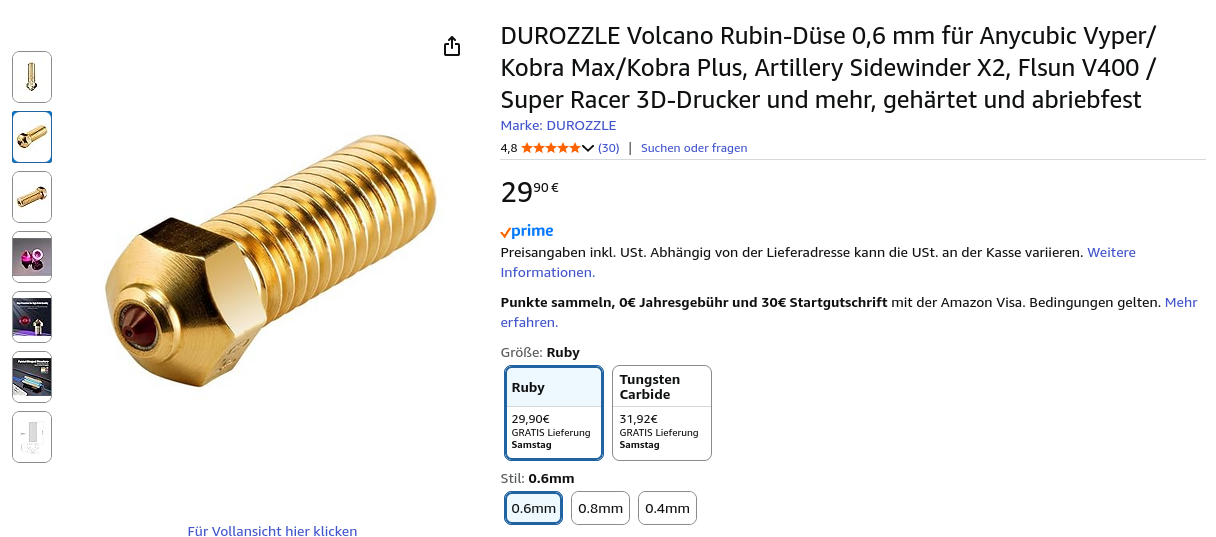
A new automated bot rush found a way around safety measures. I’m sure our admins and devs are already on it.